College of Arts and Sciences
Astronomy (M.S.)
College of Arts and Sciences
Astronomy (M.S.)
Explore the Universe — Earn Your M.S. in Astronomy at NMSU
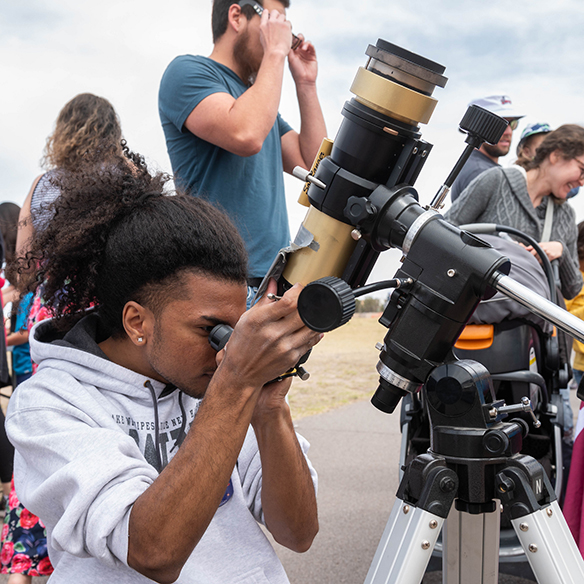
At New Mexico State University, the Master of Science in Astronomy offers an immersive research‐driven experience for aspiring astronomers and space scientists. The program covers advanced topics such as astrophysics, stellar atmospheres, observational techniques, galactic structure, cosmology, and solar system studies. Students benefit from NMSU’s southern New Mexico location — ideal for optical, infrared, and radio astronomy — and have access to world-class instrumentation and research partnerships with global teams.
Admission Deadlines
December 15 for fall admission
- Total credits: 33
Delivery Format
In-person
Career Pathways
Graduates of the M.S. in Astronomy develop strong analytical, computational, and observational skills suited for a range of scientific and technical roles. Possible career paths include:
- Observational astronomer or astrophysics researcher
- Data scientist or algorithm developer for space or satellite missions
- Telescope systems engineer or instrumentation specialist
- Science communicator, educational outreach coordinator, or planetarium director
- Technical consultant in aerospace, defense, or remote sensing industries
- Preparation for doctoral study or advanced research positions
Degree questions, answered
Have questions about the Master of Science in Astronomy? Fill out our inquiry form.
Why choose a M.S. in Astronomy at NMSU?
Choosing NMSU’s M.S. in Astronomy means joining a dynamic research community with access to remarkable skies, instrumentation, and mentorship. With dedicated faculty, direct access to local observatories, and opportunities to collaborate on international research efforts, you’ll start making contributions to the field early — and position yourself for either advanced study or impactful scientific career paths.

No GRE Required
We’re removing barriers to graduate education, which is why we don’t require the GRE.
The Astronomy M.S. program is directed to both students planning to complete a terminal M.S. degree and students planning to enter a Ph.D. program.
- Thesis track: For the Terminal Master of Science degree in Astronomy, the student must satisfy the requirements of the Department as well as those established by the Graduate School. The Department requires a minimum of 33 credits of which six are generally for Master's Thesis research.
- Course work only track: A thesis is nearly always required for a Terminal Master of Science degree. However, under some exceptional circumstances, the thesis requirement may be waived, in which case the credit requirements must be satisfied in formal course work.
Take classes like:
- ASTR 503 – Fundamentals of Astrophysics
- ASTR 506 – Dynamics and Hydrodynamics
- ASTR 620 – Planetary Processes
- ASTR 605 – Interstellar Medium
- PHYS 462 – Intermediate Electricity and Magnetism II
- EE 528 – Fundamentals of Photonics

Ready to take the next step?
Request Information
Scholarships and Financial Aid
At NMSU, we strive to offer competitively priced tuition to keep your tuition costs affordable. If you need financial aid, we’re ready to work with you to determine the best ways to finance your education.
Financial assistance includes loans, grants, and scholarship opportunities. To apply, use NMSU’s convenient Scholar Dollar$ one-stop scholarship application, which serves all students in the NMSU system.
NMSU students are also eligible for loans and grants. The first step in applying for financial aid is to complete a Free Application for Federal Student Aid (FAFSA). Learn more about financial aid opportunities at NMSU.
Contact Financial Aid
Phone: 1-888-729-6678
Email: financialaid@nmsu.edu
Accreditation
New Mexico State University is accredited by the Higher Learning Commission, an institutional accreditation agency recognized by the U.S. Department of Education. Specialized accreditation from other accrediting agencies is also granted for some programs. NMSU’s accreditation ensures that your education meets high-quality standards and that your credits are transferable.