College of Engineering
Engineering (Ph.D.)
College of Engineering
Engineering (Ph.D.)
Lead Breakthrough Innovation — Earn a Ph.D. in Engineering at NMSU
Take your engineering career to the pinnacle of innovation with a Ph.D. in Engineering from New Mexico State University. At NMSU, you're not just joining a doctoral program — you’re entering a cutting-edge research community home to six engineering disciplines, including Mechanical, Civil, Chemical, Electrical, Environmental, and Industrial Engineering.
Admission Deadlines
March 1 (fall), November 1 (spring)
- Total credits: 54-60
Delivery Format
In-person
Career Pathways
Graduates of NMSU’s Ph.D. in Engineering program are prepared to be leaders and innovators across industries. Whether advancing as a chief engineer in aerospace or energy, pioneering research as a university professor, directing labs in national research facilities, or guiding innovation in government and private sectors, our alumni turn advanced expertise into impact. With demand for engineering leadership at an all-time high, this doctorate equips you with the skills to shape technological progress, influence policy, and inspire the next generation of engineers.
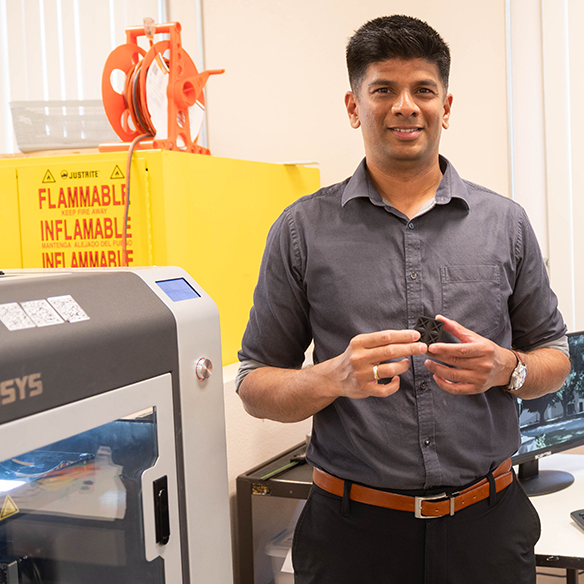


From Research to Real-World Impact — Lead with a Doctorate in Engineering
Guided by world-class faculty and fueled by NMSU’s robust research strengths in areas like energy, data science, infrastructure, and advanced manufacturing, you’ll emerge ready to redefine what’s possible in engineering — whether in industry, academia, or leadership.
You’ll gain deep expertise through rigorous coursework and doctoral research credits—typically 36 graduate credits plus 24 dissertation credits — alongside milestone-driven progress including qualifying and comprehensive exams.

Carnegie R1 Research Institution
The R1 designation represents the highest level of research excellence placing NMSU among the top 5% of universities nationwide.
The program of study leading to the Ph.D. is available to students who have either a BS or MS in chemical engineering. Students with a BS must complete 30 course credits and 24 dissertation credits, for a total of 54 credits.
Take classes like:
- CHME 594 – Professional Communication in Chemical Engineering
- CHME 542 - Graduate Reactor Analysis and Design (s)
- CHME 501 - Graduate Thermodynamics for Chemical Engineers
- CHME 516 - Graduate Numerical Methods in Chemical Engineering
The Ph.D. program in Civil Engineering is open to students with a master's degree. The program of study requires a minimum of 36 graduate credits beyond the master’s, including at least 18 credits of dissertation work. Students may specialize in environmental, geotechnical, structural, transportation, or water resources engineering. There are two options for coursework depending on existing credentials.
- Option 1 - Ph.D. with Completed Master's Degree - If the student has both bachelor's and master's degrees in fields that are not closely related to Civil Engineering, they must complete any undergraduate and graduate coursework deficiencies identified by the faculty in their area of specialization. Beyond completion of any deficiency coursework, the following requirements must be met: Pass Qualifying Exam, 18 Graduate Electives, Pass Comprehensive Exam, and Complete and Defend Doctoral Dissertation.
- Option 2 - Direct Ph.D. with BSCE or Equivalent, but no Master's Degree - If the student has the equivalent of a BSCE degree, but no master's degree, they must fulfil the following requirements: 18 credits in Area of Specialization (beyond the bachelor's degree, 450 or higher), Pass Qualifying Exam, 18 Graduate Electives, Pass Comprehensive Exam, Complete and Defend Doctoral Dissertation.
Take classes like:
- ENVE 456 - Environmental Engineering Design
- C E 510 - Introduction to Nondestructive Testing
- C E 507 - Design of Earth Retaining Structures
- A EN 478 - Irrigation and Drainage Engineering
The Ph.D. program is open to students with a master's degree. There are two options for coursework depending on existing credentials.
- Option 1 - Ph.D. with Completed Master's Degree - If the student has both master's and bachelor's degrees in fields other than electrical engineering, they must complete undergraduate deficiency coursework, consisting of completion of the BSEE core courses. If the student has a master's degree in a field other than electrical engineering, they must complete graduate deficiency coursework, which consists of three graduate core courses from three different areas of emphasis as well as pass qualifying exam, 18 Graduate Electives, Pass Comprehensive Exam and Complete and defend doctoral dissertation.
- Option 2 - Direct Ph.D. with BSEE or Equivalent, but no Master's Degree - If the student has the equivalent of a BSEE degree, but no master's degree, they must fulfil the following requirements: 10 credits in Area of Specialization (beyond the bachelor's degree, 450 or higher), Pass Qualifying Exam, 33 Graduate Electives, Pass Comprehensive Exam, Complete and Defend Doctoral Dissertation
Take classes like:
- E E 515 - Electromagnetic Theory I
- E E 523 - Analog VLSI Design
- E E 551 - Control Systems Synthesis
- E E 528 - Fundamentals of Photonics
The program of study leading to the Ph.D. degree must include a minimum of 36 graduate course credits, plus 24 dissertation research credits (9 credits at the IE 600 level and 15 credits of IE 700). Among the 36 graduate course credits, 18 credits must be from IE 500-level courses relevant to your research. Typical areas include statistics, electrical engineering, mathematics, or mechanical engineering. You may not transfer credits from your master’s degree to meet this requirement. Additional requirements include Pass Qualifying Exam, 33 Graduate Electives, Pass Comprehensive Exam, Complete and Defend Doctoral Dissertation.
Take classes like:
- I E 535 - Discrete Optimization
- I E 537 - Large Scale Systems Engineering
- I E 567 - Design and Implementation of Discrete-Event Simulation
- I E 571 - Advanced Quality Control
The Ph.D. program is open to students with a master's degree. A student is required to have one refereed journal paper accepted and a second one accepted or in review by graduation. The Ph.D. dissertation can be a compilation and reformatted version of these published or accepted journal papers. The program of study leading to the Ph.D. degree must include a minimum of 36 graduate course credits, plus 24 dissertation research credits (9 credits at the ME 600 level and ME credits of IE 700). Additional requirements include Pass Qualifying Exam, Pass Comprehensive Exam, and Complete and Defend Doctoral Dissertation.
Take classes like:
- M E 503 - Thermodynamics
- M E 517 - Nonlinear Dynamics and Chaos
- M E 518 - Finite Element Analysis
- M E 583 - Introduction to Combustion
Ph.D. students must pass:
- a qualifying examination within 24 months of starting their Ph.D. studies;
- a comprehensive examination completed a minimum of nine months prior to the dissertation defense; and
- an oral defense of the written dissertation before the dissertation committee.
- Paper #1: An archival paper accepted or published in any journal listed in the source publication list for the Web of Science, or a refereed Journal or Conference Proceeding approved by the student’s doctoral committee and the cognizant Department Head(s), before the Doctorate of Philosophy final examination. The candidate should be listed as the lead author in Paper #1.
- Paper #2: An additional archival paper submitted, accepted, or published in any journal listed in the source publication list for the Web of Science. Alternatively, one conference paper accepted or published in a national or international conference proceedings.
Scholarships and Financial Aid
At NMSU, we strive to offer competitively priced tuition to keep your tuition costs affordable. If you need financial aid, we’re ready to work with you to determine the best ways to finance your education.
Financial assistance includes loans, grants, and scholarship opportunities. To apply, use NMSU’s convenient Scholar Dollar$ one-stop scholarship application, which serves all students in the NMSU system.
NMSU students are also eligible for loans and grants. The first step in applying for financial aid is to complete a Free Application for Federal Student Aid (FAFSA). Learn more about financial aid opportunities at NMSU.
Contact Financial Aid
Phone: 1-888-729-6678
Email: financialaid@nmsu.edu
Accreditation
New Mexico State University is accredited by the Higher Learning Commission, an institutional accreditation agency recognized by the U.S. Department of Education. Specialized accreditation from other accrediting agencies is also granted for some programs. NMSU’s accreditation ensures that your education meets high-quality standards and that your credits are transferable.